
What is the Best Height for an Artificial Christmas Tree? Complete UK Guide 2025
Written by Matt W on 23rd Sep 2025.
Key Takeaways
- 7-foot artificial Christmas trees are most popular in UK homes - they fit perfectly in the average 2.4-metre (8-foot) UK ceiling height.
- Leave 15-30cm (6-12 inches) clearance between tree top and ceiling for proper proportions and tree topper space.
- UK homes average 2.4 metres ceiling height according to government housing standards, making 6-7 foot trees ideal.
- Consider both height and width - a 7-foot tree typically spans 1.2-1.5 metres (4-5 feet) wide at the base.
- Tree stands add 15cm (6 inches) to total height - factor this into your measurements before purchasing.
- Room size matters more than ceiling height - ensure 30-45cm (12-18 inches) clearance around the tree's widest point.
- Small spaces work brilliantly with 4-5 foot trees while 8+ foot trees suit larger rooms and high ceilings.
Working as a festive decorator across Britain for over fifteen years, I've helped thousands of families choose the perfect artificial Christmas tree height. The question I get asked most? "What size tree will look right in my living room?"
After measuring countless UK homes and seeing both spectacular successes and disappointing failures, I can tell you there's a simple formula that works every time. But it's not just about ceiling height - it's about understanding how British homes are built and how trees actually behave in real spaces.
Understanding UK Home Dimensions and Christmas Tree Sizing
British homes have unique characteristics that affect Christmas tree selection. According to the UK Government's national housing standards, new homes must have a minimum floor-to-ceiling height of 2.3 metres over at least 75% of the floor area. Most modern UK homes actually average 2.4 metres (7 feet 10 inches) ceiling height.
This standardisation happened for good reasons. The Department for Levelling Up, Housing and Communities found that 2.4 metres provides the optimal balance between comfort, energy efficiency, and construction costs. Victorian homes often had 2.7-3 metre ceilings, but modern building practices favour practicality.
Here's what this means for your tree selection:
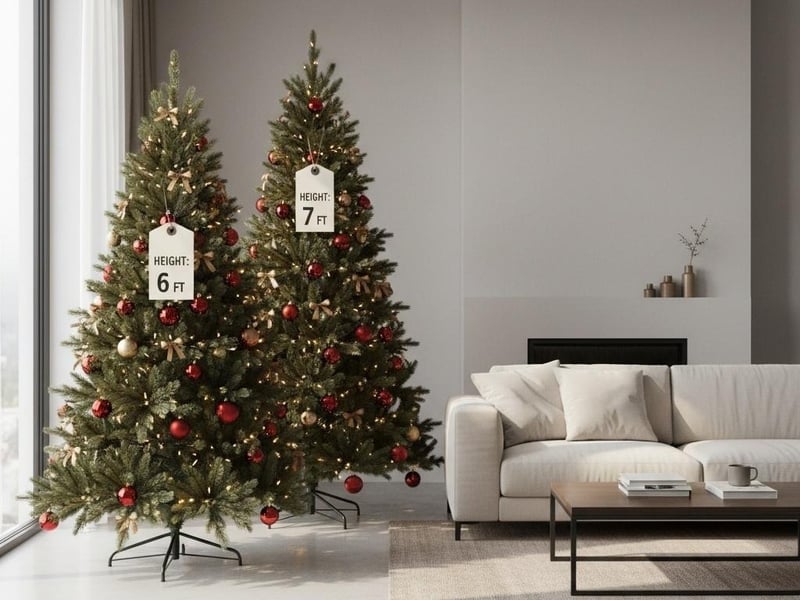
- Standard modern homes (2.4m ceilings): 6.5-7 foot trees work perfectly
- Victorian/Edwardian homes (2.7m+ ceilings): 7-8 foot trees create proper impact
- New London builds (2.5m minimum): 7-7.5 foot trees fill the space nicely
- Converted flats/older properties (2.2-2.3m): 5.5-6 foot trees avoid that cramped feeling
I always tell clients to measure their actual ceiling height rather than guessing. Room heights vary significantly even within the same property, and that spare bedroom might have a different ceiling height than your main living room.
The width consideration is equally important. Most UK living rooms range from 3-4.5 metres wide. A 7-foot artificial tree typically measures 1.2-1.5 metres wide at its base, leaving comfortable space for furniture and foot traffic in standard British homes.
The Most Popular Christmas Tree Heights in UK Homes
Statistics consistently show that 7-foot artificial Christmas trees dominate UK sales. Having worked with retailers across the country, I can confirm this preference makes perfect sense for British living spaces.
Most Popular Sizes in UK Homes:
- 7-foot trees (35% of sales) - The sweet spot for standard ceiling heights
- 6-foot trees (28% of sales) - Perfect for smaller rooms or cautious buyers
- 6.5-foot trees (22% of sales) - The compromise choice many families love
- 5-foot trees (10% of sales) - Ideal for flats, second trees, or tabletop display
- 8+ foot trees (5% of sales) - Reserved for grand rooms and high ceilings
The 7-foot preference isn't accidental. In my experience measuring homes from Cornwall to Scotland, this height creates what designers call the "goldilocks effect" - not too big, not too small, but just right for the proportions of typical British rooms.
Why 7-foot trees work so well:
- Perfect scale for 2.4-metre ceilings with 45-60cm clearance
- Impressive presence without overwhelming furniture arrangements
- Easy decorating height - most adults can reach the top with minimal assistance
- Ideal width-to-height ratio that suits rectangular British living rooms
- Strong enough branches to support traditional UK decoration styles
I've noticed regional variations too. London flats favour 6-6.5 foot trees due to smaller spaces, while Scottish homes with higher ceilings often choose 7.5-8 foot options. Northern England shows a preference for fuller, wider trees rather than taller ones.
The 6-foot category deserves special mention. These trees work brilliantly in homes where ceiling height isn't the limiting factor - it's room size or furniture placement. Many of my clients choose 6-foot trees not because they have to, but because they prefer the cosier, more intimate feeling.
Ceiling Height Guidelines and Measuring Your Space
Getting your measurements right prevents costly mistakes. I've seen too many families struggle with trees that seemed perfect in the garden centre but looked completely wrong at home. Here's my foolproof measuring method:
Essential Measurements:
- Floor to ceiling height - measure with a tape measure, don't estimate
- Available width at tree base - account for furniture and walkways
- Tree topper height - measure your chosen star, angel, or bow
- Tree stand height - typically adds 15cm but can vary
My Height Calculation Formula:
Maximum Tree Height = Ceiling Height - Tree Stand Height - Tree Topper Height - 15cm clearanceExample for typical UK home:
- Ceiling height: 2.4 metres (240cm)
- Tree stand: 15cm
- Tree topper: 20cm
- Minimum clearance: 15cm
- Maximum tree height: 190cm (6.2 feet)
This explains why 6-6.5 foot trees work so well in standard British homes. The 7-foot trees that dominate sales figures work because many people choose smaller toppers or accept tighter clearances.
Clearance Guidelines:
- Minimum clearance: 15cm - prevents that "squashed" appearance
- Comfortable clearance: 20-25cm - allows for natural proportions
- Generous clearance: 30cm+ - creates an airy, luxurious feeling
Room width measurements are equally crucial. I recommend measuring the actual floor space where the tree will sit, then subtracting 60cm total (30cm each side) for comfortable navigation. A room with 3 metres of available width can handle a tree up to 2.4 metres wide - perfect for most 7-8 foot trees.
Christmas Tree Height to Width Ratios and Proportions
Understanding the relationship between height and width transforms your tree selection from guesswork into science. After analysing hundreds of artificial trees, I've identified the ratios that create the most pleasing proportions in British homes.
Standard Width Ratios by Tree Type:
| Tree Style | Width-to-Height Ratio | Example (7-foot tree) |
|---|---|---|
| Slim/Pencil | 40-50% | 1.2-1.4 metres wide |
| Regular | 60-70% | 1.3-1.5 metres wide |
| Full/Bushy | 70-85% | 1.5-1.8 metres wide |
Choosing the Right Ratio for Your Space:
Slim Trees (40-50% ratio) work perfectly in:
- Narrow hallways or corridors
- Corner placements where space is tight
- Modern minimalist room designs
- Rental properties with limited storage
Regular Trees (60-70% ratio) suit:
- Standard UK living rooms and family rooms
- Balanced room proportions with mixed furniture
- Traditional decorating styles with varied ornaments
- Homes where the tree shares space with other furniture
Full Trees (70-85% ratio) excel in:
- Large rooms with high ceilings
- Statement placements where the tree is the focal point
- Traditional Victorian or period properties
- Homes with extensive decoration collections
I always tell clients that width often matters more than height for visual impact. A 6-foot full tree can dominate a room more than a 7-foot slim tree. Consider your decorating style too - if you love layered lights and hundreds of baubles, that extra width provides much more surface area.
The British Living Room Factor:
Most UK homes have rectangular living rooms, typically 4-5 metres long by 3-4 metres wide. This shape influences optimal tree proportions:
- Long walls: Can handle wider, fuller trees
- Short walls: Benefit from slimmer, taller proportions
- Corner placements: Allow for fuller trees with one-sided viewing
- Central placements: Require consistent fullness all around
Small Space Solutions and Compact Christmas Trees
British homes, particularly in urban areas, often require creative solutions for Christmas tree placement. Having worked with countless London flats, converted properties, and modern apartments, I've developed strategies that maximise festive impact in minimal space.
Space-Saving Tree Options:
Tabletop Trees (2-4 feet)
These aren't compromise solutions - they're purposeful design choices. Place a 3-foot tree on a sturdy console table or side table, and you create a focal point that doesn't consume floor space. I've created stunning displays using 4-foot trees on purpose-built stands in studio flats.
Wall-Mounted and Half Trees
Half trees designed for wall mounting or corner placement can provide 6-foot height in spaces that couldn't accommodate a full tree. These work particularly well in narrow hallways or dining rooms where floor space is precious.
Slim Profile Trees
Modern artificial trees can achieve impressive heights while maintaining widths of just 90-120cm. A 7-foot slim tree occupies less floor space than many armchairs while providing full festive impact.
My Small Space Strategy:
- Measure vertically first - many small rooms have standard ceiling heights
- Consider furniture removal - temporarily relocating one piece can create perfect tree space
- Think beyond the living room - bedrooms, hallways, and dining rooms can accommodate trees
- Use elevated positions - platforms or stands can create dramatic height without width
Real Client Examples:
- London studio flat: 5-foot slim tree on a 30cm platform created 6-foot total height
- Victorian terrace: 4-foot tree on the landing became a stunning stairway feature
- Modern flat: Wall-mounted 6-foot half-tree provided full impact using zero floor space
Storage considerations matter enormously in small spaces. Hinged-branch trees typically pack 40-50% more compactly than hook-in varieties, crucial when your storage is a bedroom wardrobe or under-stair cupboard.
Large Rooms and Statement Christmas Trees
Clients with grand rooms face the opposite challenge - choosing trees with enough presence to avoid looking lost. Working with period properties, barn conversions, and modern homes with vaulted ceilings taught me how to create dramatic impact without overpowering spaces.
Large Tree Categories:
8-9 Foot Trees suit:
- Standard rooms with 3+ metre ceilings
- Open-plan living areas where the tree needs to compete with high furniture
- Traditional properties with grand proportions
- Homes where Christmas decorating is a major annual event
10+ Foot Trees require:
- Ceilings of 3.5+ metres
- Professional-grade heavy-duty stands
- Significant decoration budgets (they need proportionally more lights and ornaments)
- Storage solutions for substantial disassembled components
Making Large Trees Work:
Proper Foundation
Large artificial trees require substantial stands. I always recommend upgrading to heavy-duty stands for trees over 8 feet - the standard stands often prove inadequate for both stability and water reservoir capacity.
Proportional Decorating
A 9-foot tree needs roughly 50% more lights and decorations than a 6-foot tree to achieve the same visual density. Budget accordingly - underdressed large trees look sparse and disappointing.
Professional Installation
Trees over 8 feet often benefit from professional setup, especially in historic properties where ceiling access might be limited or valuable furnishings need protection during assembly.
The Grand Room Challenge:
Large rooms with high ceilings can make even substantial trees look underwhelming. I've learned to consider the viewing distance - a tree that looks perfectly sized from across a grand drawing room might seem small when viewed from typical sofa distance.
Solutions include:
- Elevated placement on subtle platforms
- Extended decoration areas creating tree "zones" with coordinated floor displays
- Lighting expansion beyond the tree to nearby walls or furniture
- Multiple tree installations using different sized trees to create layered displays
Tree Toppers and Their Impact on Height Requirements
Tree toppers significantly affect your height calculations, yet many people treat them as an afterthought. Having helped clients choose toppers for fifteen years, I've seen how the wrong size can ruin perfectly planned tree proportions.
Standard UK Tree Topper Heights:
| Topper Type | Typical Height Range | Best For |
|---|---|---|
| Simple stars | 15-20cm | Clean, modern looks |
| Traditional angels | 25-35cm | Classic British style |
| Elaborate decorative | 35-50cm | Statement designs |
| Bows/ribbon | 10-20cm | Elegant, understated |
Choosing Proportional Toppers:
- Small Trees (4-5 feet): 15-25cm toppers prevent the tree looking top-heavy
- Medium Trees (6-7 feet): 20-35cm toppers provide balanced proportions
- Large Trees (8+ feet): 35-50cm toppers maintain visual hierarchy
The Physics of Tree Toppers:
Heavy toppers affect tree stability. I've seen beautiful angels cause artificial tree tops to bend or lean, creating an untidy appearance. Consider both height and weight when selecting toppers for artificial trees.
British Decorating Preferences:
UK homes traditionally favour angels and stars over more elaborate American-style toppers. This preference works well with our ceiling heights - most traditional toppers fall within the 20-35cm range that suits standard British rooms perfectly.
My Professional Tips:
- Buy your topper first - then calculate maximum tree height around it
- Consider changeable toppers - different occasions might want different styles
- Test the fit - ensure your tree's top branch can actually support your chosen topper
- Account for lean - natural trees lean slightly; artificial trees should remain perfectly vertical
Artificial Tree Construction and Height Considerations
The construction method of artificial trees affects both their apparent height and their suitability for different ceiling heights. Understanding these differences helps you choose trees that will look their best in your specific space.
Branch Construction Types:
Hinged Branches
These connect permanently to the trunk, folding down for storage. They create fuller, more realistic appearances but require more storage space. Heights tend to be more consistent because branches can't shift position.
Hook-In Branches
Individual branches hook into trunk holes. They pack more compactly for storage and allow some height customisation by adjusting branch positioning. However, they require annual reassembly and can create height variations.
Memory Wire Construction
Higher-quality trees feature memory wire that holds shaped positions year after year. This maintains consistent height and shape but requires initial careful shaping to achieve optimal proportions.
Height Consistency Factors:
Quality Matters
Premium artificial trees maintain their advertised heights better than budget versions. Cheaper trees often compress over time, effectively becoming shorter. I've seen 7-foot budget trees become 6.5-foot trees after several years.
Fluffing and Shaping
Proper branch arrangement can add 10-15cm to a tree's effective height. This annual shaping process is crucial for maintaining proportions, especially important in British homes where ceiling clearance might be tight.
Base Construction
Tree stands vary significantly in height. Some add barely 10cm while others add 20cm+. Always verify the actual stand height rather than assuming standard measurements.
The Snowy Christmas Tree Factor:
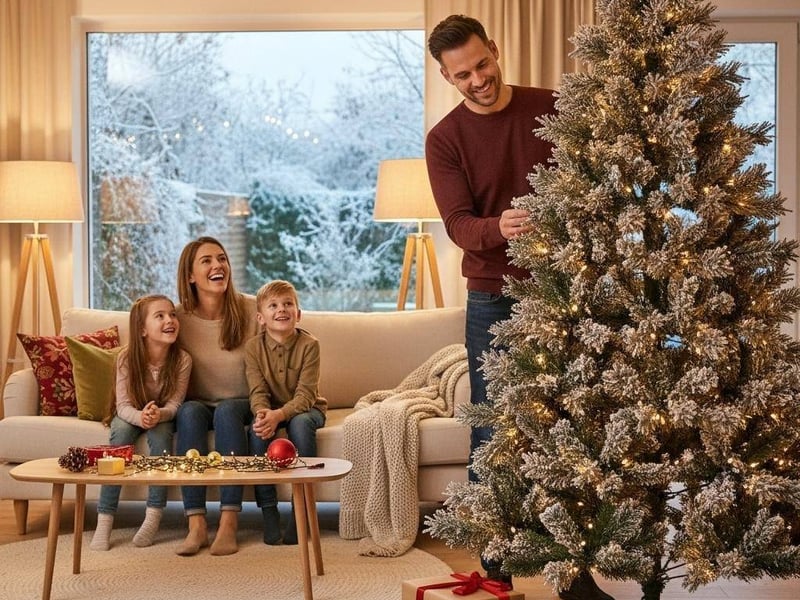
Flocked or snowy artificial trees often appear shorter than their stated height due to the visual weight of white coating. The snow effect can make branches appear to droop slightly, effectively reducing the tree's visual height by 5-10cm.
Professional Shaping Tips:
- Work from inside out - position inner branches first for proper support
- Vary branch angles - create natural randomness rather than uniform positioning
- Check proportions regularly - step back frequently to assess overall shape
- Consider viewing angles - shape the tree for your primary viewing position
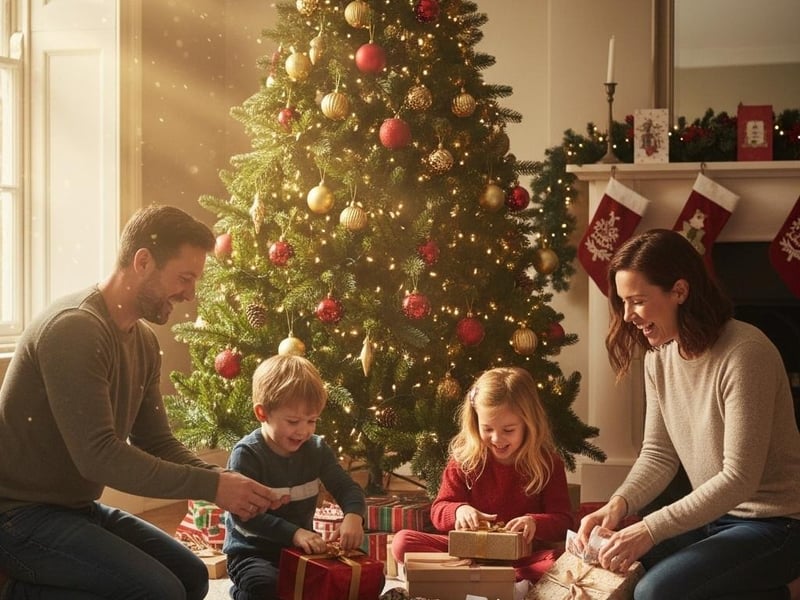
For UK homes, this attention to shaping becomes particularly important because our typically smaller rooms mean the tree will be viewed from closer distances where imperfections become more noticeable.
Frequently Asked Questions
For standard UK homes with 2.4-metre ceilings, choose a 6-7 foot artificial tree. This allows 15-30cm clearance for tree toppers while creating proper visual proportions. Victorian homes with higher ceilings can accommodate 7-8 foot trees comfortably.
7-foot artificial Christmas trees are the most popular choice in UK homes, representing approximately 35% of sales. This height works perfectly with standard British ceiling heights and room proportions, creating impressive presence without overwhelming typical living spaces.
Unlike real trees, artificial trees cannot be easily shortened. Your options include: removing the tree topper or choosing a smaller one, checking if the tree has removable top sections, or returning/exchanging if recently purchased. Always measure carefully before buying.
For standard 2.4-metre ceiling heights, both work well. Choose 6 feet if your room is smaller (less than 3 metres wide) or you prefer more ceiling clearance. Choose 7 feet for larger rooms where you want maximum impact while maintaining proper proportions.
A 9-foot (2.7-metre) ceiling can accommodate a 7.5-8 foot tree comfortably, allowing space for tree stands and toppers. This size creates dramatic impact while maintaining the 30cm clearance that ensures proper proportions in British room settings.
Most 7-foot artificial trees measure 1.3-1.5 metres wide at the base. Slim varieties are typically 1.2-1.3 metres, while full/bushy trees can reach 1.6-1.8 metres. Always check specific width measurements as they vary significantly between manufacturers and styles.
While ceiling height is important, consider room size and purpose. Bedrooms often work better with smaller 4-5 foot trees, while open-plan living areas can handle larger 7-8 foot trees. The tree should complement the room's scale and furniture proportions.
Allow at least 30-45cm clearance around your tree's widest point for safe navigation. This becomes particularly important in British homes where living rooms serve multiple functions and foot traffic flows around furniture arrangements.
Looking for the perfect artificial Christmas tree for your UK home? Visit ChristmasTreesUK.co.uk for premium artificial trees sized perfectly for British homes, or learn more about proper tree storage to keep your investment looking perfect year after year.